

Paper 1: The Socialized Tools of Power (STOP)
Social Architecture Diagnostic Trilogy - Movement I: Regulation
Published: July 7, 2026Intro
Legitimacy as Necessity
We all want to be considered legitimate at something.
Legitimacy provides us with social rewards that are desirable: belonging, status, access, and authority, to name a few. It can also provide us with something foundational to how we view ourselves: identity.
Legitimacy provides us with socially validated markers of credibility and belonging that shape how we understand ourselves and our place in the world. Because of this, legitimacy and identity are often intertwined; association with a legitimacy structure becomes a piece in the construction of our own self-concept. When asked who they are, many people answer with their profession. Individuals become resolute supporters of their alma mater. A friend group can help someone answer questions like, "Who am I, and where do I belong?”
From the countryside to the street corner, from the essential worker to the corporate executive, people desire legitimacy, but it can’t be distributed equally. Human attention, trust, expertise, and decision-making are finite. Imagine a world where everyone could claim to be an expert on healthy living — how could you sort through all of the different ideas being proposed without missing something?
Legitimacy helps us filter information, decision-making, and attention for necessary social coordination. Social systems, then, help us decide who is credible, an authority, and relevant through the distribution of legitimacy, since no one individual can fully evaluate every claim, idea, person, or possibility equally.
The distribution of legitimacy shapes the social architecture of our societies.
Legitimacy Preservation
Once legitimacy is granted to individuals through a legitimacy structure, people are incentivized to protect it. It provides them with identity, belonging, status, authority, and credibility, so perceived threats to legitimacy are existential. The desire to preserve legitimacy shapes human behavior.
Individuals learn legitimacy-preserving behaviors through ordinary social participation. When identity and legitimacy are entangled, these behaviors become adaptive, shaping an individual’s sense of self. These adaptive behaviors are not explicitly taught, but observed over time and internalized, becoming an adaptive behavioral grammar, normalized as social convention.
These adaptive behaviors also protect the legitimacy structure itself. Individuals are rewarded with promotions, status, and recognition when they apply these behaviors to protect the legitimacy structure to which they are attached. This creates a self-sustaining loop of protection and maintenance, with members protecting both their own legitimacy and the legitimacy of the structure.
We encounter these behaviors in everyday interactions. These socialized protective behaviors are not always conscious, but they are utilized so commonly that we can see them used across social contexts predictably. They are normalized within society at all levels.
Legitimacy Preservation in Everyday Life
Take, for example, an employee working in a corporate office. This employee has been working at their new job for a few months now and has many ideas they’d like to share to improve the inner workings of their team.
At the end of a team meeting, the team leader asks if anyone has any closing thoughts they’d like to share, and, after a moment of hesitation, this new employee shares an idea for the team to start their days with check-ins, in an effort to help teammates problem-solve any projects that they might be working on.
The team, made up of members who have been in their roles for at least a year or two, doesn’t want to add anything to their plates. The idea of having the new employee implement an idea so early in their tenure would shift the team's decision-making dynamic out of group control. Instead of sharing feedback, positive or constructive, when the team leader asks for thoughts on the new employee’s idea, the team goes silent.
The team leader, unsure of what others are thinking, thanks the employee for the idea, but tells them they won’t be adding check-ins as part of the team’s routine to avoid disrupting the team’s flow.
The employee’s idea receives no feedback. Over time, the new employee becomes slower to share new ideas and gradually adapts to learn which ideas are treated as disruptive and which are welcomed. Without any explicit discussion, the group collectively avoids voicing ideas that could change their routines.
Intro to STOP Framework
This is one form of what I call the Socialized Tools of Power (STOP). This diagnostic framework identifies patterned behaviors that individuals and institutions use to preserve legitimacy, regulate access, and reproduce existing power structures.
These behaviors are not isolated interpersonal flaws, but recurring legitimacy-preserving tactics meant to regulate clarity, recognition, perception, and proximity. Each behavior is not about individual intent but about the patterned effect: forcing the individual experiencing the behavior to expend cognitive and emotional labor interpreting the gap between what is being signaled and what is actually being protected.
In this paper, I’ll explore four Socialized Tools Of Power: Silence as Strategy, Tokenism and Timing, Optics over Integrity, and Performative Proximity.
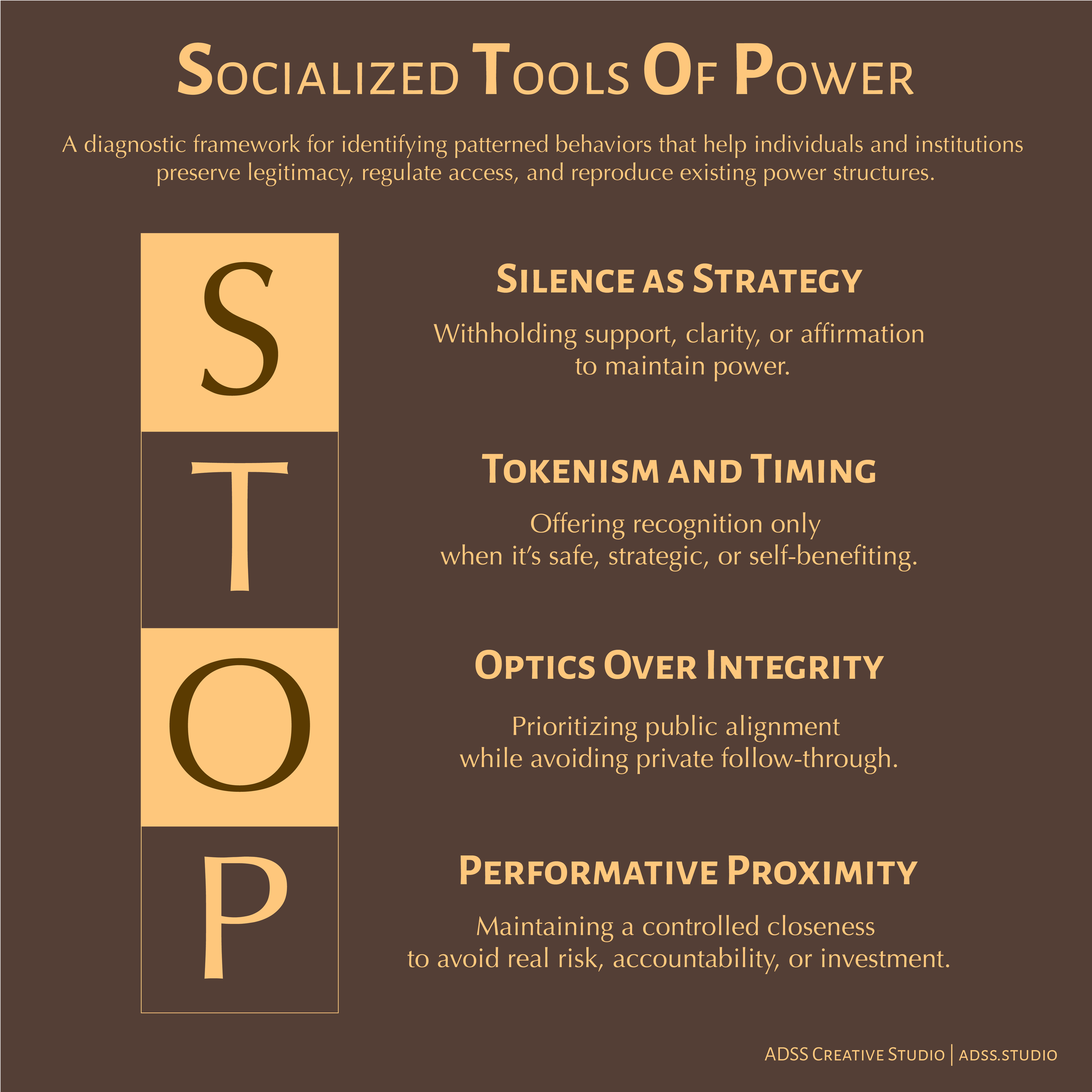
STOP (Socialized Tools Of Power)
S - SILENCE AS STRATEGY
Withholding support, clarity, or affirmation to maintain power.
Silence as Strategy is about regulating clarity.
Silence as Strategy is not about individual intent, but the patterned effect of forcing the person experiencing the silence to do the emotional labor of decoding why the silence exists in the first place.
Silence is a valuable tool to preserve legitimacy and maintain control because there’s no quote for no response; not saying anything allows for plausible deniability.
It can be used when someone steps beyond what is expected of them or disrupts expectations. Withholding a reaction becomes a tool to make the individual question themselves, while also maintaining control of the situation.
Interpersonally, this type of behavior is experienced often. A silence after a thought is shared by an “outsider” is a learned response. The silence is an unspoken way to mark a boundary. The person experiencing the silence is left in a state of ambiguity, unsure of whether what they said is wrong, if they offended someone, or any number of other reasons for the lack of response they received.
This silence doesn’t have to be planned if it’s done by a group of people. It can be the shared awareness that the person is stepping outside of the group’s expectations, and the common, normalized response to maintain control or status by saying nothing.
We see this often with teams that have leaders who abuse power. For an individual team member to speak up and call out the bad behavior of a superior, the cost is high. It could mean losing their job, which would result in losing a major part of their identity, money, status, and belonging.
The organization would have its own legitimacy threatened, and would have to go through great efforts to prove this person was abusing their power, which costs time, resources, and money. It is often easier to remain silent, maintain your position and status, and say nothing.
Silence is the strategy.
At the institutional level, this is often experienced as a lack of response. Applying for opportunities, institutions build silence into their operations. It may be communicated as due to a high volume of applications for an opportunity or role, or simply that the individual’s communication is of low priority to the institution. Whether intentional or not, silence results in the same predictable outcome: a lack of clarity that the individual is forced to decipher.
Institutions have the ability to grant legitimacy to individuals, so a lack of response can produce a lack of legitimacy.
T - TOKENISM AND TIMING
Offering recognition only when it's safe, strategic, or self-benefiting.
Tokenism and Timing are behaviors that regulate recognition.
One of the ways we preserve legitimacy is by controlling when someone gets publicly recognized. When those with lower distributions of legitimacy are granted higher visibility, it has the potential to disrupt existing hierarchies and power dynamics. To maintain the status quo, Tokenism and Timing can be a tactic used to provide recognition without destabilizing one’s own position.
On the interpersonal level, Tokenism and Timing are used specifically when the person, group, or institution attempting to maintain their position has an opening to offer recognition that won’t destabilize their own status.
In the creative world, we can see examples of this. An artist can offer recognition to another only when that recognition doesn’t exceed their own. The artist may share another’s work on social media when the accomplishment is locally celebrated within a small artist community, but purposely avoid recognizing the other artist when they are celebrated more widely — like from a regional arts magazine — to limit the other artist’s exposure. Tokenism and Timing here serve to provide recognition when it’s safe and the absence of recognition when it could risk their own legitimacy.
Institutions operate in Tokenism and Timing as well. Within an organization, an employee of a marginalized group may be deployed carefully, allowing this individual to greet prospective candidates who are also from marginalized groups, while being excluded from the decision-making process related to hiring. They are visible enough to signal inclusion, while also held at bay to avoid actual decision-making power.
The individual may wonder, “Why am I trusted to greet these candidates, but my voice isn’t part of whether they should be hired?”
In both scenarios, recognition is offered when it serves to protect an individual’s or institution’s legitimacy, but withheld when it might threaten it.
O - OPTICS OVER INTEGRITY
Prioritizing public alignment while avoiding private follow-through.
Optics over Integrity is about regulating perception.
Oftentimes, our stated values, individually or institutionally, are aspirational compared to how we actually operate. Optics over Integrity allows for the signaling of alignment with values that are socially desired, while avoiding substantive change.
A homogeneous team gets a new leader who is different from the group. In order to signal inclusion, the team performs polite engagement with the news of their hiring, posting congratulatory messages on LinkedIn. Though once the new leader is in place, the ideas they propose are consistently met with resistance and doubt, undermining their authority. Through Optics over Integrity, changes that the new leader tries to implement are either delayed or avoided, maintaining the status quo and allowing informal power to remain with the group rather than the leader.
We can also see this behavior in institutions. Within them, not all visibility is equal. We see the empty calories of visibility with organizations that promote the diversity of their teams, while maintaining a monoculture among their leadership. The leadership gets to commend themselves on promoting the visibility of its members without ever being forced to ask themselves why those with different backgrounds are not among the leadership team itself.
Optics over Integrity values perception over the experience of individuals, because aligning both would require change, and change often redistributes the allocation of legitimacy, control, and authority.
P - PERFORMATIVE PROXIMITY
Maintaining a controlled closeness to avoid real risk, accountability, or investment.
Performative proximity is about regulating access.
People want to be associated with others depending on what that connection might cost or gain them. These associations may connect us with these resources, providing an incentive to keep these people in our orbit. Most people want to maintain that association, but without risking anything themselves. It's a social escape hatch — if this person continues to accumulate status and authority, I want to continue to associate with them, but if they do something that loses public favor, I want to be able to remove my association.
Performative Proximity is the name of this calculated dance.
In a workplace, a new person with an impressive resume is hired. When they announce that they could use some help on a project they’re working on, you look for ways you can participate without fully committing. If the project seems to be going well, you’ll invest more time and visibility alongside this colleague, and if not, you want to be able to distance yourself in case the project becomes a mess.
Being that institutions rely on their reputation as their legitimacy, Performative Proximity is especially curated. Arts institutions may celebrate an independent creator’s work by sharing it on social media, but when that creator applies for a grant that the institution provides, they may get rejected because their work is too experimental. Those with decision-making power don’t want to invest in work that doesn’t have an already established lane.
Performative Proximity can be a standard mode of operation for individuals and institutions when working with others, limiting the potential of what true collaboration can create.
3 Core Functions of STOP Behaviors
All four STOP behaviors are learned, adapted to as normal, and deployed, serving 3 main functions: survival, regulation, and reproduction. These functions rarely operate in isolation, as STOP behaviors may simultaneously be used for all three purposes.
Survival
Once granted legitimacy by a legitimacy structure, individuals must protect it to maintain their identity, status, and belonging. STOP then becomes a survival mechanism.
To avoid punishment, individuals may use Silence as Strategy to avoid naming a truth that could be socially jeopardizing if exposed. To avoid a talented new coworker from receiving too much recognition, Tokenism and Timing may be used to manage their visibility.
STOP behaviors are used at all levels within a legitimacy structure, from those who are granted the most, to those who have been allocated the least, because once an individual’s legitimacy is put into question, so too is their own identity — leading to emotionally charged responses to protect themselves and their belonging.
Those who hold the least amount of allocated legitimacy may rely heavily on STOP behaviors because their positions are often the most precarious. Group in-fighting, pettiness, gossip, and hostile interpersonal relations are common manifestations of groups of individuals jostling over fragile legitimacy distributions.
The greater the legitimacy one accumulates, the greater the potential loss. A person who has been promoted from intern to director within an organization may internalize STOP as their conditioned professional demeanor because these behaviors have been repeatedly reinforced throughout their career.
Regulation
STOP behaviors are also used to regulate the distribution of legitimacy to others.
Individuals do not always behave in accordance with their allocated legitimacy. An employee may challenge the decision of leadership. Children speak out of turn to their parents. When a disruption of expectations by an individual or group threatens the established hierarchy and puts legitimacy into question, STOP behaviors are used to enforce the status quo, maintain boundaries of roles, or create ambiguity in the service of control.
Regulation is often visible — to set the standard for what is and is not tolerated. While STOP behavior in service of survival may be interpersonal, STOP behavior in service of regulation is about setting a tone for others to learn the boundaries set in place by those with higher allocated legitimacy distributions.
Reproduction
Learning the behavioral grammar of STOP happens through common interactions with others and navigating legitimacy structures. STOP behaviors are reproduced by individuals without direct instruction. One’s survival and success within a legitimacy structure is determined by how well they can internalize and reproduce these adaptive behaviors to protect their own and the structure’s legitimacy.
Seeing those with more authority and access to power exercising these behaviors creates an incentive for them to be reproduced by those with less. When engaged with those who are not cultured in the grammar of selective silences, managed engagement, or ambiguity norms, it can create clear distinctions of who’s in and who’s out, and who to disregard as illegitimate in themselves.
The corporate world disguises this as the unspoken cultural norms that dictate the daily operations and affect career advancement.
Why STOP Matters
Taken altogether, the behaviors outlined in STOP are meant to preserve appearances. Preserve the appearance that a system is fair, reasonable, and functioning properly. If that appearance is stable, legitimacy remains in place, and the standard mode of operating cannot be called into question, because doing so would call into question a seemingly objective system. Individuals, then, are forced to reckon with their own lack of reasonability, while the legitimacy structure never has to face its own biases.
STOP doesn’t require coercion, as legitimacy structures incentivize adapting to this behavioral grammar as the standard mode of operating. It naturally rewards those who adopt this behavioral grammar by providing them with identity, access, status, promotions, and belonging in exchange.
Even those harmed by STOP learn to internalize the behaviors as their position within a legitimacy structure changes. STOP becomes part of how the social architecture of spaces is formed, without ever considering if alternative builds are available, reproducing cycles of harmful, existing power structures.
While legitimacy structures may be a vital part of any modern society for social coordination, STOP is not. STOP creates unhealthy work environments where the emotional labor to decode this behavior is pushed downstream to individuals with the least amount of legitimacy to challenge it in the first place. Individuals are forced to question themselves, and never the structures, as doing so comes with high social costs.
Structure, process, and order are all valuable, but when they are enforced to stifle expression, suppress insight, and limit innovation, they become a cage disguised as a foundation.
By naming these behaviors, people gain the ability to recognize and interrupt these micro-moments of legitimacy preservation. By doing so, it helps people make sense of their reality as patterned behaviors that are not normal but are incentivized.
Interruption becomes a starting place for new ways of belonging.
Limitations
The STOP framework does not encompass all the ways in which legitimacy is maintained socially or institutionally. This set of behaviors is common enough to identify across interpersonal, cultural, and institutional situations, but humans are way too complex to identify every example of legitimacy-preserving behavior.
STOP should be used to identify patterns, not isolated incidents. People forget to respond to an email. They can be unaware that they are only showing token support for an individual. They may know they are protecting an authority figure by not naming their abuse of power, but be unsure of how else they are supposed to operate without risking their career.
STOP is an adaptive behavioral grammar, and only once we are aware of these legitimacy-preserving behaviors can we begin to think of new ways to allow for legitimacy structures to serve their role in society, while simultaneously allowing for curiosity, expression, and engagement to coexist.
Conclusion
Legitimacy is a necessary part of societal social coordination. Legitimacy structures allocate legitimacy in helpful ways, and by doing so, they lower our cognitive load and provide shortcuts to whom we should trust and consider for various tasks, ideas, and decisions.
Because legitimacy cannot be distributed equally, individuals have a strong incentive to protect their allocated amount. This incentive creates adaptive behaviors that individuals and institutions use to protect their presumed legitimacy. Over time, this protective function can become regulatory in ways that exceed legitimacy’s original coordinating purpose.
The STOP framework identifies four legitimacy-preserving behaviors meant to regulate clarity, recognition, perception, and proximity: Silence as Strategy, Tokenism and Timing, Optics over Integrity, and Performative Proximity. These adaptive behaviors serve three purposes: survival, regulation, and reproduction, becoming a behavioral language one must learn in order to survive and navigate a legitimacy structure, no matter the individual’s allocated legitimacy.
These behaviors replicate across society, creating harmful power structures that punish the questioning of alternative options of belonging and incentivize conformity. By identifying these behaviors that can often be hard to name, we can interrupt these patterns of behavior and find healthier ways to belong together.
Legitimacy can be preserved without psychological harm.
Mirror Moment
STOP behaviors are so common that it would be easy to call out others (individuals, groups, or institutions) for using them, but oftentimes, we may ignore how we are using these behaviors ourselves.
Individuals lead institutions and learn to internalize and replicate the same legitimacy-preserving behaviors outlined in STOP.
Reflect on your own behavior. What STOP behaviors do you use, with whom, and in what situations? How could you engage without trying to control others in the same space?
Glossary
Legitimacy - The socially granted recognition that a person, idea, role, or institution is credible, meaningful, authoritative, or worthy of trust.
Legitimacy Structures - Any social system that distributes recognition, authority, belonging, or opportunity.
Adaptive Behavioral Grammar - A set of socially learned behaviors that become normalized through repetition, reward, and observation rather than explicit instruction.
Social Architecture - The patterns of belonging, authority, and relationship that emerge from how legitimacy is distributed within a social system.
Related Reading
The following works explore adjacent themes including status, legitimacy, identity, social coordination, and impression management. Their inclusion does not imply agreement or direct influence on the framework presented here.
Erving Goffman, The Presentation of Self in Everyday Life — foundational for performance, impression management, and social self-regulation.
Will Storr, The Status Game — investigates status-seeking as a fundamental feature of human social life.
Daniel Kahneman, Thinking, Fast and Slow — helpful for understanding cognitive shortcuts and decision-making under limited information.
Pierre Bourdieu, Language and Symbolic Power — useful for how social power gets carried through everyday interaction.
Judith Butler, Excitable Speech — helpful for language, injury, social force, and the politics of speech.
Robin DiAngelo, White Fragility — useful as a public-facing source on defensive social behavior and legitimacy protection.
Tressie McMillan Cottom, Thick — strong for social reading, racialized perception, and institutional legibility.
Author’s Note
STOP is a diagnostic framework within Social Architecture Analysis, a branch of Experiential Language Architecture (ELA)™, a framework that designs language to reshape human experience in real time. Developed by Armstead Dickerson, a language architect, originator of ELA, and founder of ADSS Creative Studio.