CAPA Versescape:
Case Study
Published: March 25, 2026
By Armstead Dickerson
I. Client Context
After launching ADSS Creative Studio in early November 2025, I began to research potential partners for one of the studio offerings -- Versescapes, immersive poetry environments. My first Versescape was executed at Small Works Gallery in March 2025, and I was looking to expand its audience.
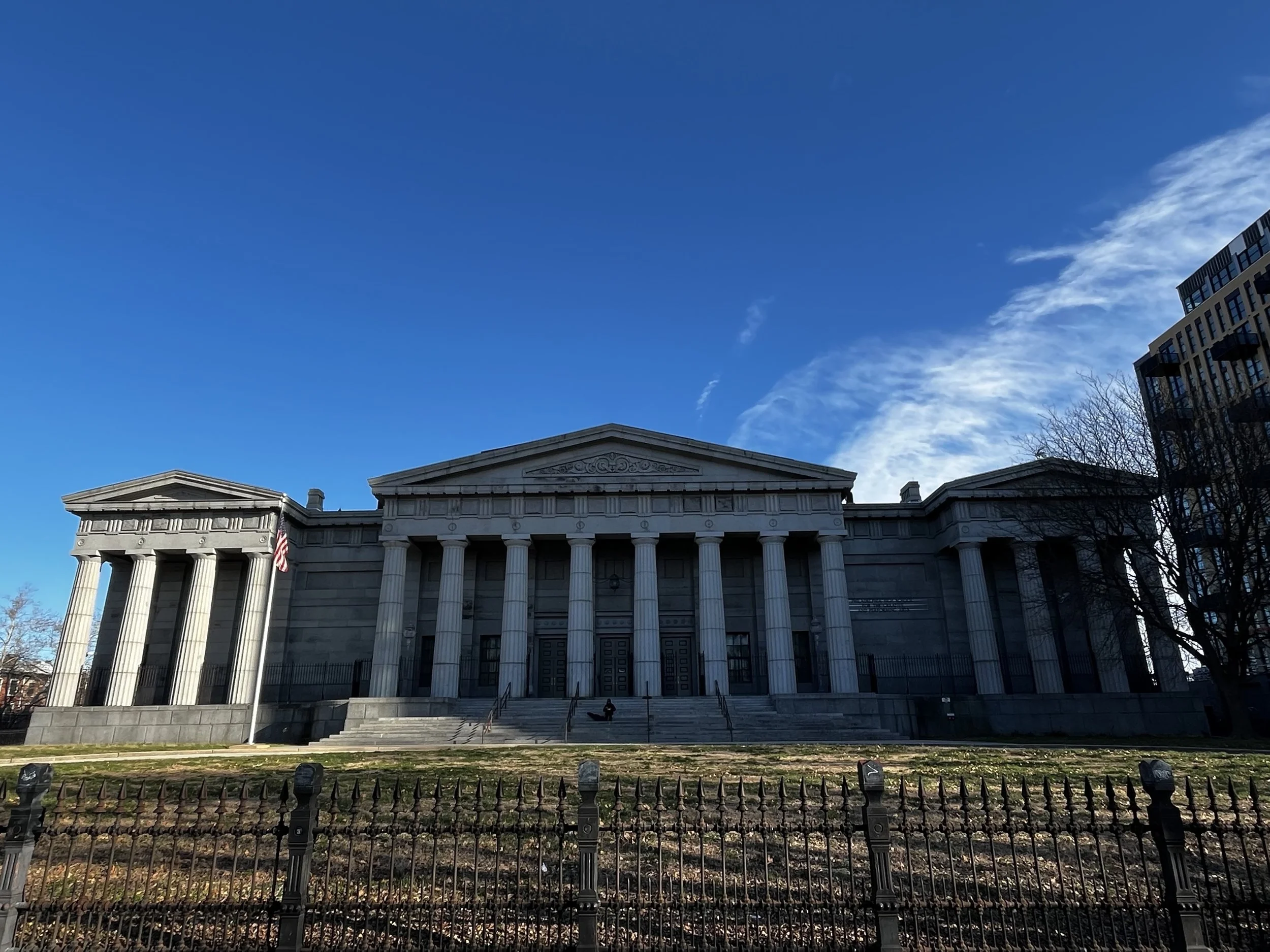
While I continued to reach out to a few aligned galleries, I also wanted to explore what a Versescape would look like for non-profits and cultural institutions. I’m a former teacher and an avid walker. Walking to my South Philly apartment along Broad Street one day, I looked to my left and stared at a large stone building I had seen many times, but had never given much thought to. It was Philadelphia’s Creative and Performing Arts High School, also known as CAPA. When I got home, I decided to research the school and noticed they had a Creative Writing Department. I reached out to the head, Rachel Harr.
A little less than a month later, in mid-December, Rachel and I were able to connect. She mentioned that creative writing students' curriculum delayed learning about poetry until senior year, and many of the freshmen, sophomores, and juniors were “starving” for exposure to the art form. She also mentioned that the creative writing team was looking for more ways to display student writing besides their two annual shows of spoken word and an event called the Writer’s Cafe.
The Creative Writing Department at CAPA receives grant funding from Kelly Writers House at the University of Pennsylvania for arts programming. The Versescape fit within that relationship -- meeting the department's need for poetry exposure across grade levels and creating an opportunity for student writing to have public visibility.
We decided on the first week of March 2026 as the best time for the Versescape, before their Writer’s Cafe later in the month.
This partnership became an opportunity to test Versescape as both a pedagogical tool and a live interpretive experience within a structured academic environment.
II. Planning Process
After agreeing upon dates, on January 9th, 2026, I went to CAPA to meet Rachel for a site visit. I prepared an agenda for us to review, which included the following:
Class sizes & space logistics
Performance & participation logistics
Documentation & Consent
Activity Selection
Installation Elements
Materials & Needs
Session Outline
The Versescape would take place in the school’s Black Box theater for one week. The freshmen, sophomores, and juniors would attend the Versescape on three separate days during the week for the full experience during their writing class. Each group was between 14 and 23 students. Rachel worked with the theater teacher, Ms. Kramny, to ensure it was okay that I used the space.
For the performance cycle, participants use Mentimeter to respond to prompts and share their thinking as a jumping-off point for group discussion. I was fortunate that Rachel and CAPA had trust in their students to use their phones for the Versescape performances. Also, all CAPA students signed waivers at the beginning of the year to consent to being photographed and videoed.
I discussed with Rachel the post-experience survey, which I provide a link to at the end of the experience, to use as feedback and data to help ensure that the Versescape format stays iterative as I continue on into the future. It’s anonymized and administered digitally, and we agreed that I would share data with the school and she would be able to review a draft beforehand.
The Versescape, in its current format has 3 guaranteed components: the Performance cycle, Textual Tapestries, and the Living Journal. I briefly introduced the other two feasible options: Typewriter and Poetry Pieces, of which Rachel chose the typewriter. She mentioned that students had not used one before and it would be a fun opportunity for exposure for the students.
We reviewed a brief session outline so she could get an idea of how each would look. Each class session was 90 minutes. After running my first Versescape last year, one of the key learnings was that the audience was hesitant to engage with most of the installation, outside of the Textual Tapestries. During the closing weekend, I noticed audience hesitation and introduced guided tours as a structural response. For CAPA, I built that learning directly into the session outline.
Versescape Session Outline (90 minutes per grade)
Welcome & Orientation (5 minutes)
Introduction to Versescape, expectations for movement, writing, and device use.Guided Introduction to the Installation (5 minutes)
Overview of the space and interactive elements.Student Exploration of Versescape (15 minutes)
Writing, reflection, and interaction with displayed poems and prompts.Performance & Participation Framework (5 minutes)
Explanation of how the performance and discussion will work.Interactive Performance & Guided Discussion (40 minutes)
Live poetry performance with facilitated reflection and peer interpretation.Post-Experience Reflection Survey (5 minutes)
Short digital survey capturing student responses and insights.Extended Exploration / Optional Activities (10 minutes)
Continued writing, revisiting the installation, or creative response.Closing (5 minutes)
Final reflections and transition back to class.
For the interactive performances, like the Versescape itself, I wanted co-creation to be a design principle for how this experience was shaped for the students. While I had 4 poems and discussions ready to go from last year, I was ready to allow for the modularity of the format to become a feature, allowing the performance to shape itself to the audience. Since this was my first time with high schoolers, I was curious what direction Rachel would choose. I shared with her a PDF copy of Thoughts and Feelings About BEing HUMAN after our meeting for her selection.
We closed by going over a materials checklist, dividing up who would be responsible for what. Adhesives, access to a screen, and a couple of tables were the main materials needed. Many of the others I had from my first Versescape.
III. Setup
Location: Philadelphia’s Creative and Performing Arts High School (CAPA)
Room: Black Box Theater
Dates: March 2nd - 6th, 2026
Tuesday, March 3rd (8am - 9:30am) - Freshmen
Wednesday, March 4th (1:30pm - 3:00pm) - Sophomores
Friday, March 6th - (9:38am - 11:10am) - Juniors
This Versescape was intentionally scaled down from the 2025 installation to better fit a classroom-based environment. It included the following components:
Textual Tapestries (2)
The Typewriter Exchange
The Living Journal
Versescape Performance Cycle
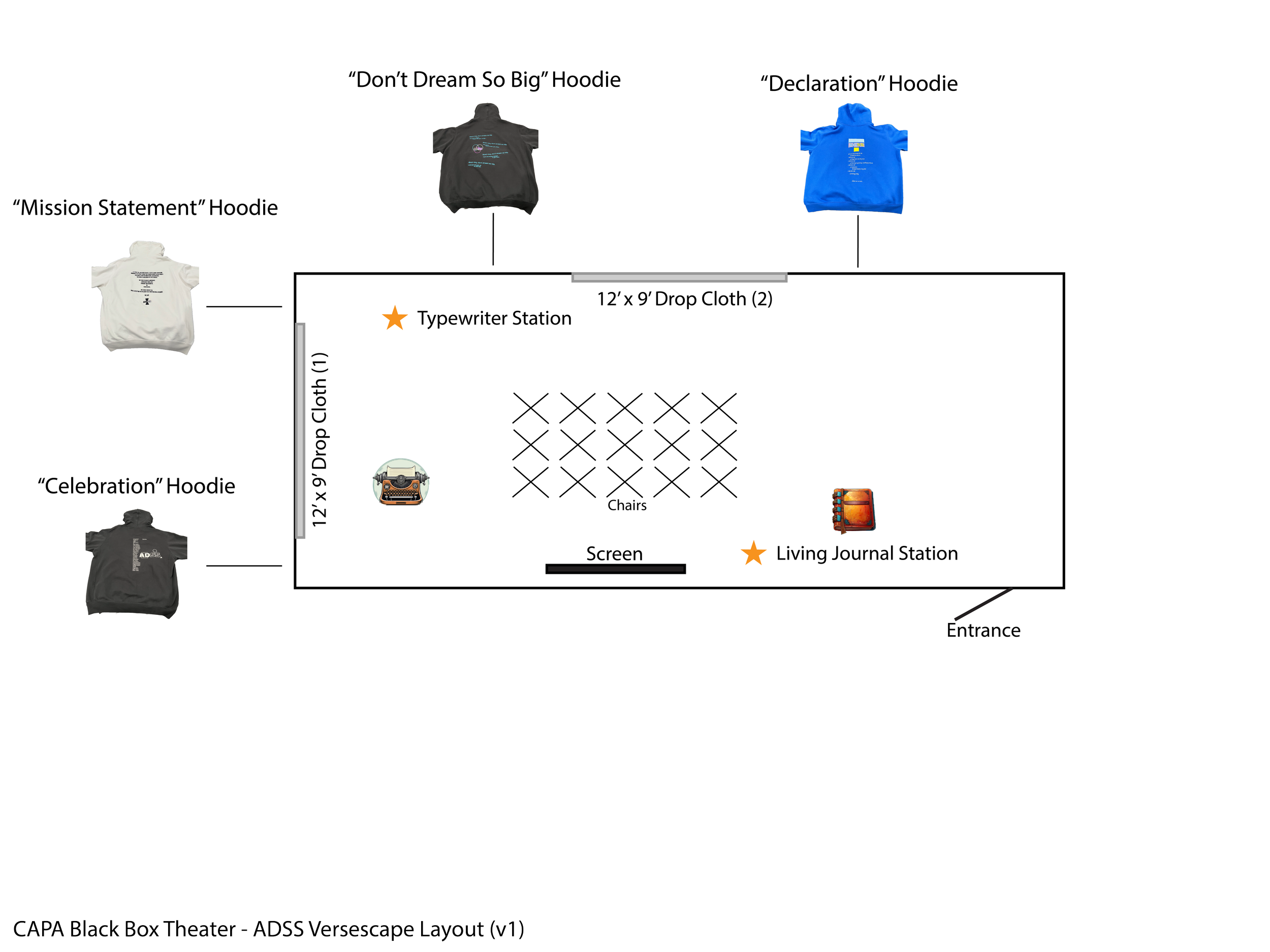
Versescape Layout
The layout illustrates how the installation was designed to guide circular movement through the space, balancing open exploration with structured interaction points.
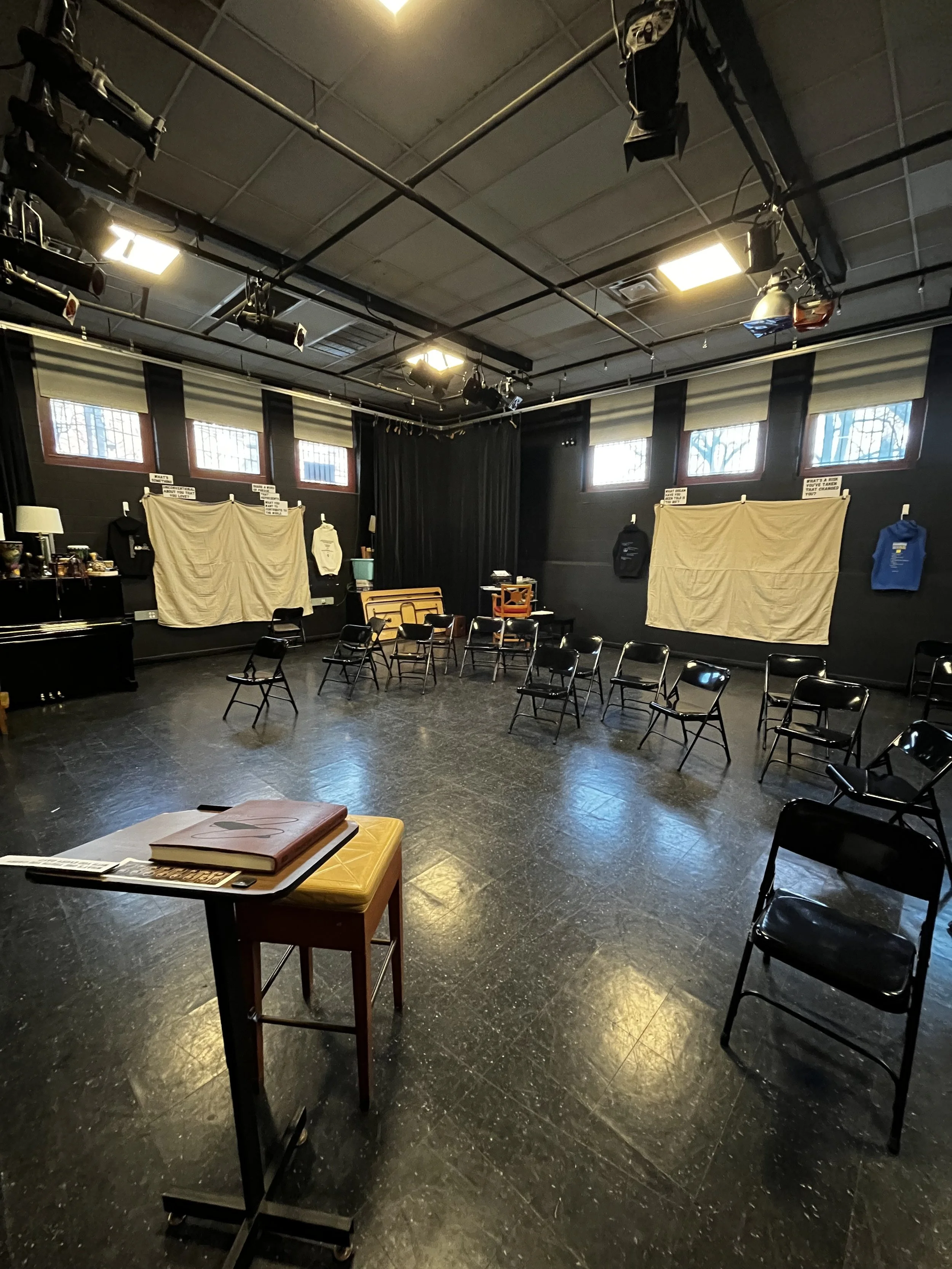
CAPA’s Black Box was a large open space, with black concrete cinderblocks for walls, with tables, chairs, and miscellaneous theater items against all four walls. Upon entering, the theater teacher’s desk was in the back right corner, with a large table with many items against the right wall. To the left was a smartboard against the “front” wall. On the far left was a movable piano, and against the far wall, long tables with chairs. When I visited, students were on their feet interacting with one another, chairs somewhat scattered, in the center of the space.
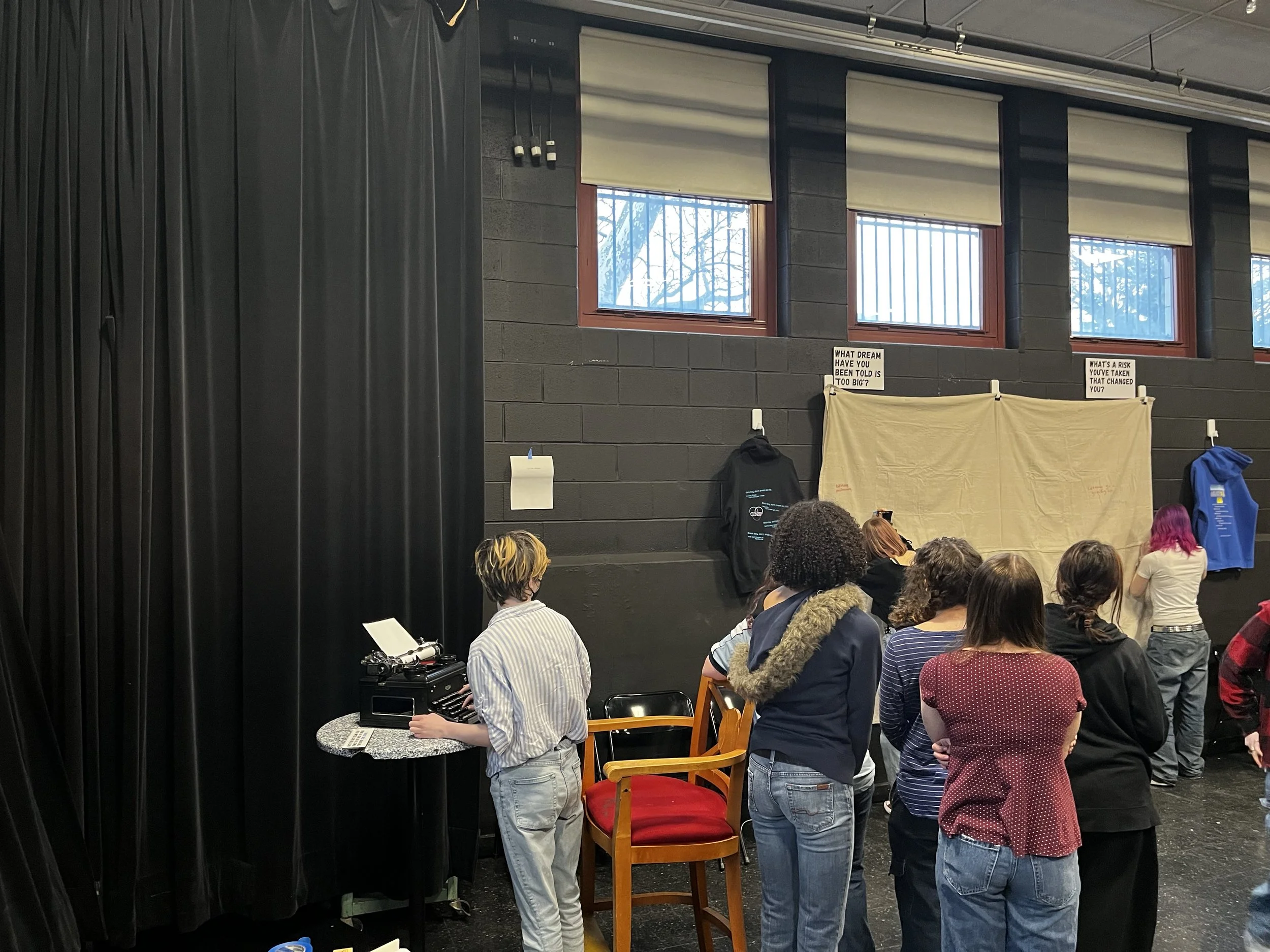
Because Ms. Kramny’s desk was large and the items on the table near the right wall were many, I decided that the back wall and the wall on the far left would be best for the Textual Tapestries. She was open to moving the piano, which also helped. The typewriter and the Living Journal are portable which allows for flexibility in their placement, so I decided to place the journal near the front and the typewriter in between both tapestry walls. This served two purposes: guiding students through a circular flow of movement, and distributing activity across the full room rather than concentrating it in one area.
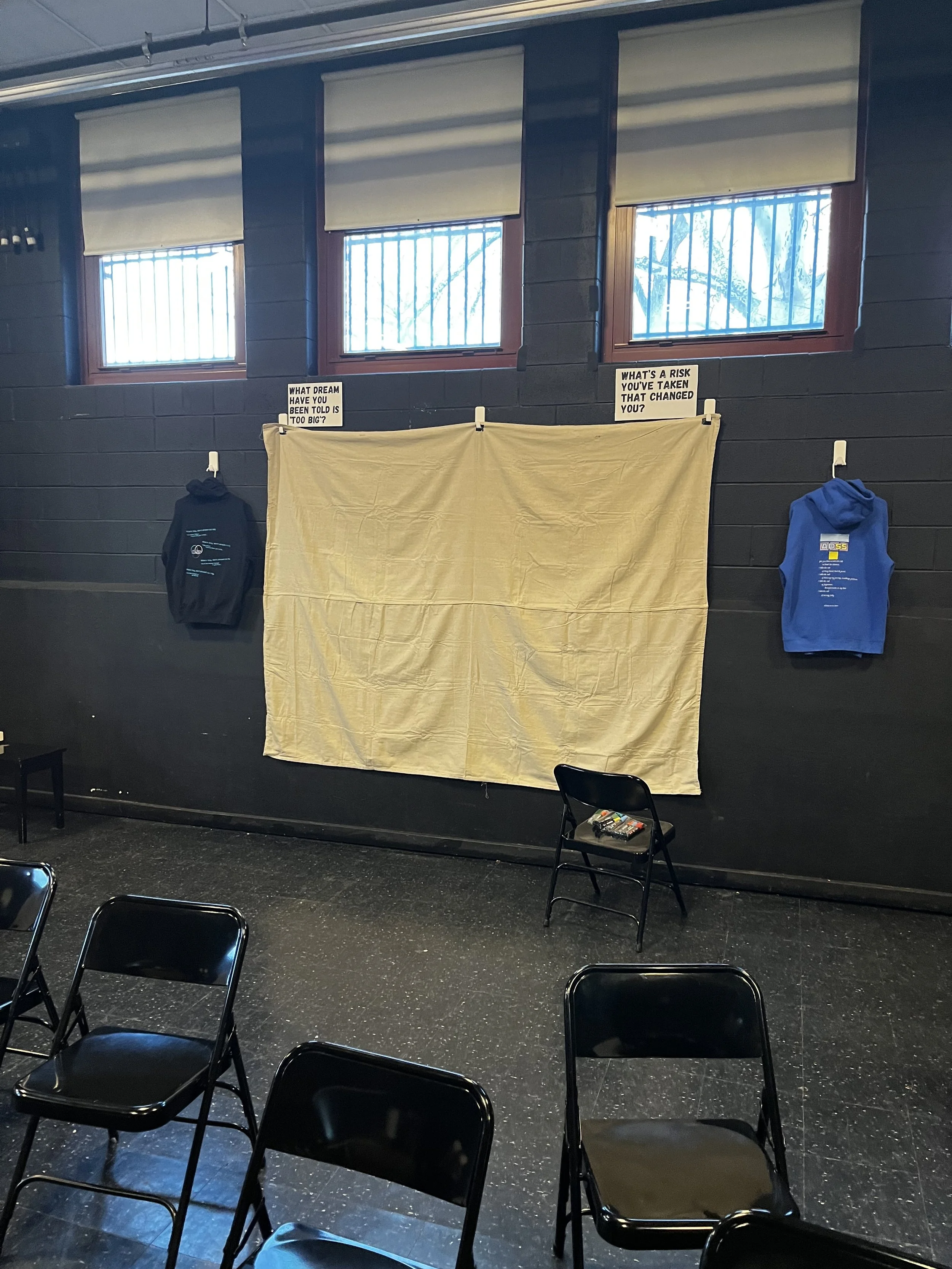
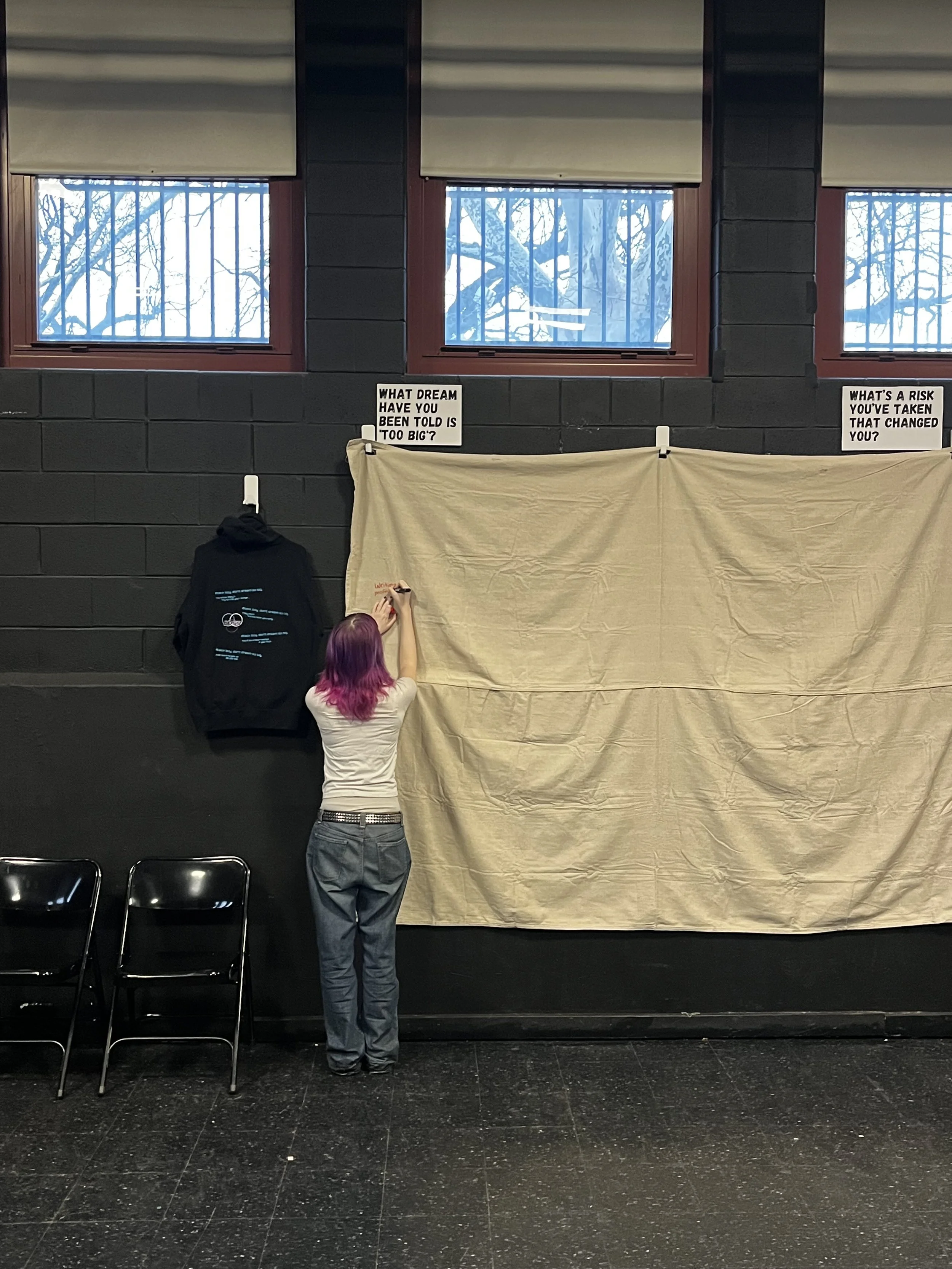
For each tapestry, two of my ADSS poem hoodies would be hung on either side. This was a change from my first Versescape, where I had not only the hoodies, but the poem prints framed next to them as well. I intentionally moved away from a gallery-style presentation to reduce the distance between the student and the work, creating an environment that invited interaction rather than observation.
The tapestries needed to be large enough for about 50 students each, so I chose the second largest I could find, 6ft x 9ft Canvas medium-duty dropcloths.
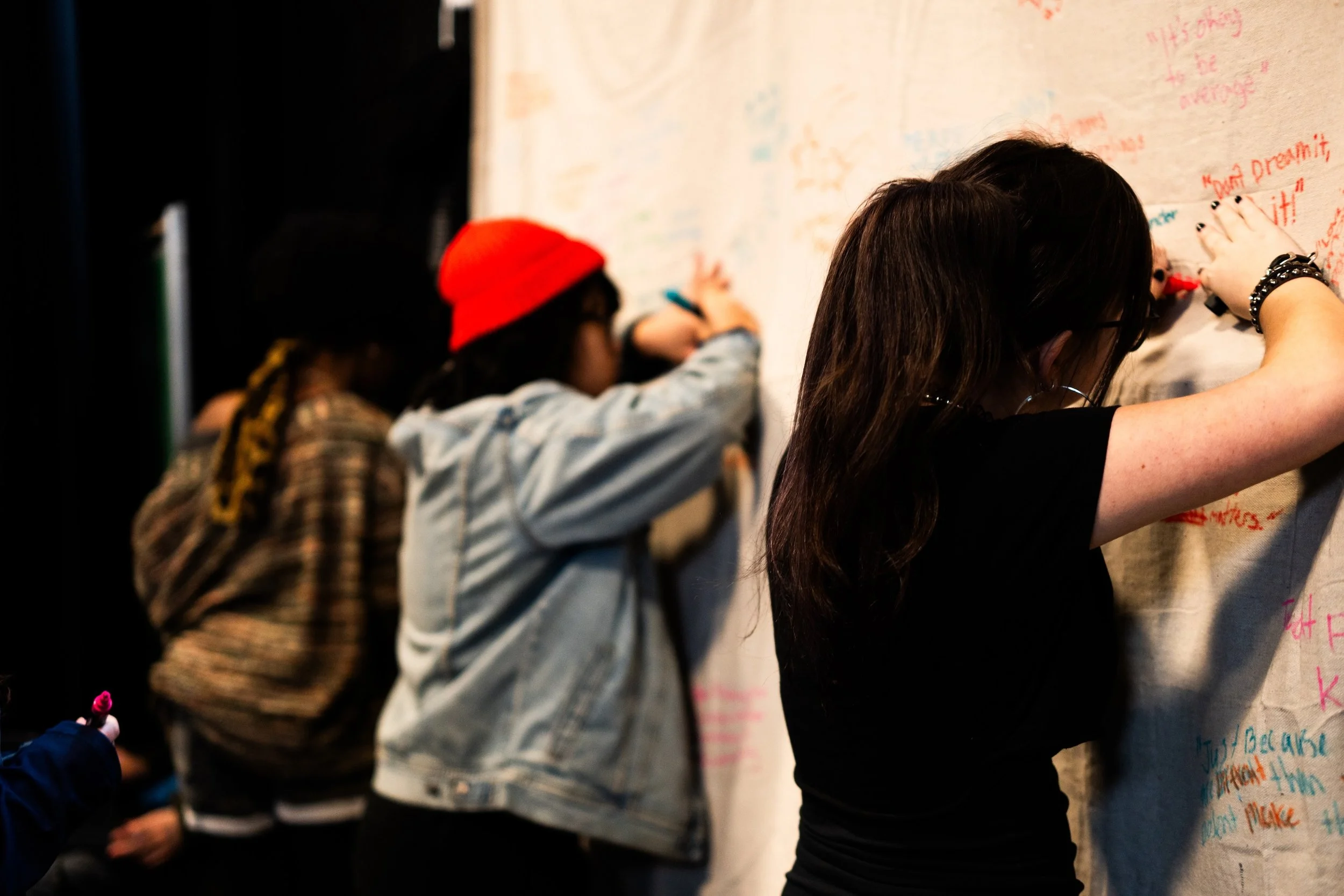
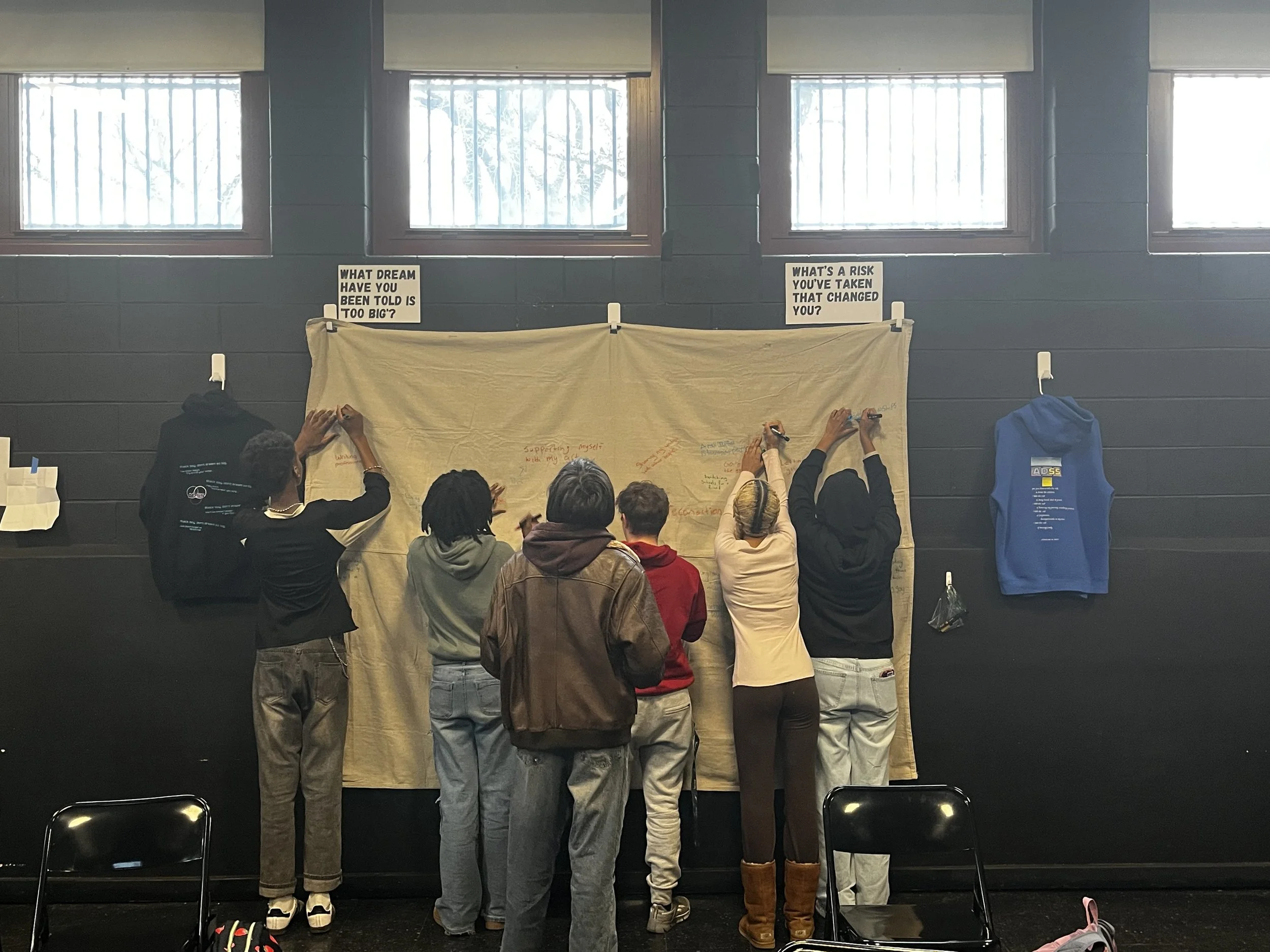
For the Textual Tapestries -- walls with dropcloth draped over them for direct writing by participants, I used three 10lb adhesive Command hooks to hang them. To prep the dropcloths, I cut 3 slits across the top, covered in black duct tape to prevent fraying. The hoodies were hung with the same hooks, using plastic clothes hangers to display them.
The poem prompts, which live on foam core, were hung using small adhesive velcro squares, two per prompt. Two attached to the prompt, and two attached to the walls. Prompts for the typewriter and journal were attached to the desks they rested on, one each.
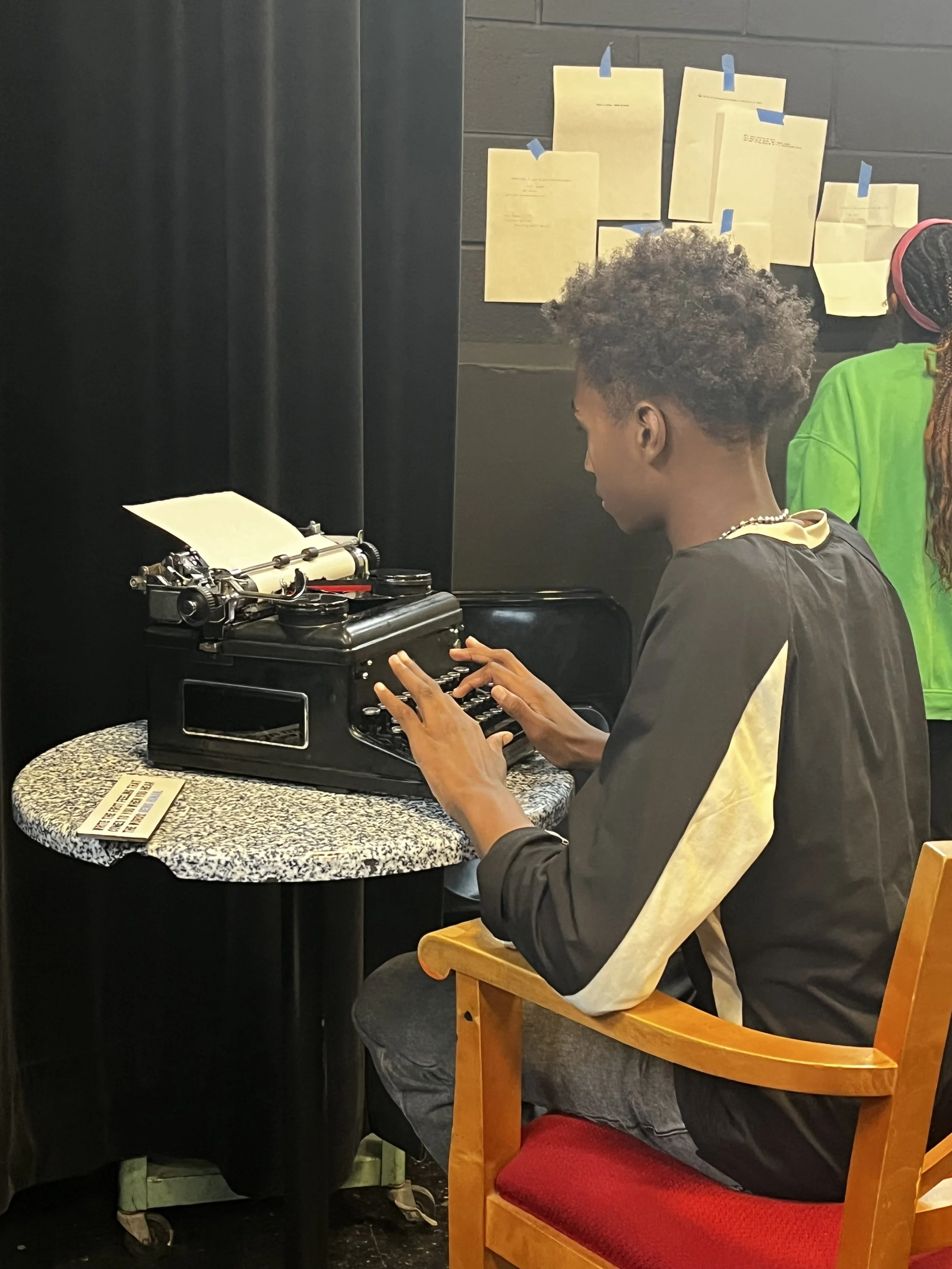
The typewriter was borrowed from Philly Typewriter on Passyunk. They have a generous borrowing program, and I hope to continue working with them in future installations. The journal was made from my first Versescape and will travel with me to each Versescape I do.
The Versescape was installed on Friday, February 27, 2026, after school. While I told Rachel the install could take multiple hours, it was completed in under an hour, reinforcing the portability and efficiency of the installation.
IV. Execution
While the session structure remained consistent across all three grade levels, the lived experience of each group revealed key differences in engagement, pacing, and response. I began each cold, no introduction to who I was, or what they were about to experience, with the opening poem from my project, “Declaration”. With all my work, I’ve learned that with experiential work, it’s best to lead with the experience, rather than explanation.
It was Wednesday, with the sophomores, where this start had the most visible impact. The students were sitting down in small groups. There was a small subset that were waiting on me to start after the teacher said they were ready.
I was debating in my head whether to call their attention for a moment, but instead, I launched into the first lines of my poem, with enough voice to fill the room.
“You just have to take the risk...”
A few students scrambled to their seats. Heads turned towards me. The room fell silent. There were a few laughs as I continued on, but the focus was on the performance. The natural pauses of a cappella poetry leave what could be uncomfortable silences to students, but they are built into the poems themselves.
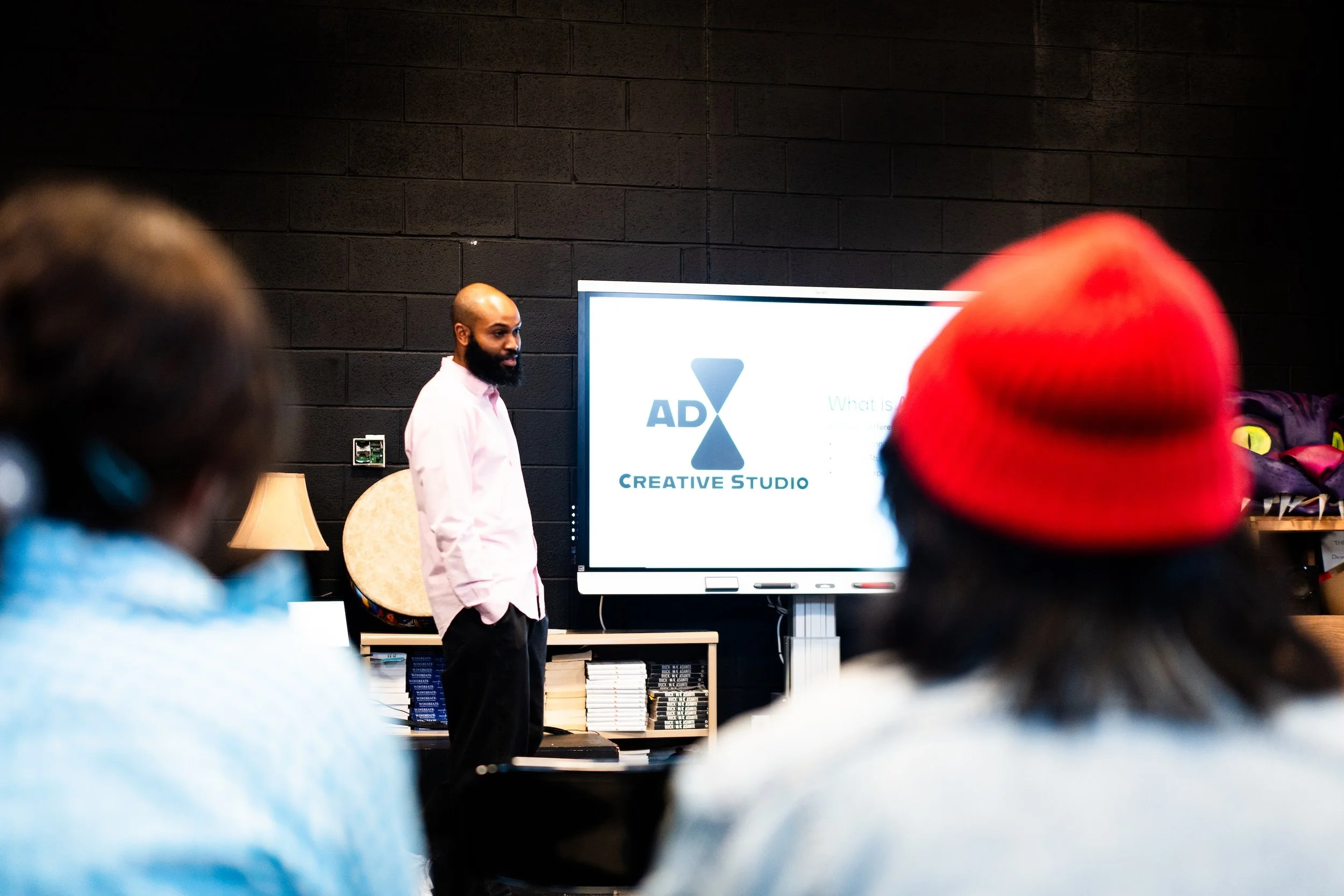
With the freshmen on the first day, after the poem, I transitioned to introducing myself and my work. I then took students around the Versescape for the guided tour. While I had set aside 15 minutes for students to explore, on this first day, I was a bit antsy and wondering if the students were getting bored, so I cut the time approximately six minutes short and got into the performance cycle sooner.
In the survey data for the freshmen, which I had access to immediately after the session, one student wrote,
“I found the premises of the poems interesting, but the execution was uninteresting and unoriginal, and downright pretentious in some parts.”
While I wasn’t bothered by the comment, I was taken aback. Clearly, this freshman was not impressed. All jokes aside, they made me consider what parts of their experience and the way I was facilitating were leading to this conclusion. While it was a single response, I treated it as a useful signal rather than an outlier. I also wasn’t going to shrink myself for their comfort. I did some reflecting on how I could lead, even more with experience, before talking about who I was.
I decided to tweak the beginning of the session the following day, for the sophomores, so that after the cold open performance, I would immediately shift into the guided tour, and then introduce myself and give context on ADSS and Experiential Language Architecture (ELA). This way, students experienced not just the poem, but the environment, and added their voices to it, before learning anything about me.
The feedback from the two other sessions did not include any similar comments to those of the freshman.
For each grade level, they truly embraced the environment and interacted with each installation piece. The Textual Tapestries naturally attracted most students. The freshmen were put in the tough position of being the youngest, but the first ones to break the ice. After a sole student wrote the first marks on one of the tapestries, slowly but surely, the students engaged with the entire installation. In the following sessions with the sophomores and juniors, many would take a moment to read what was already on the tapestry before adding their own voice.
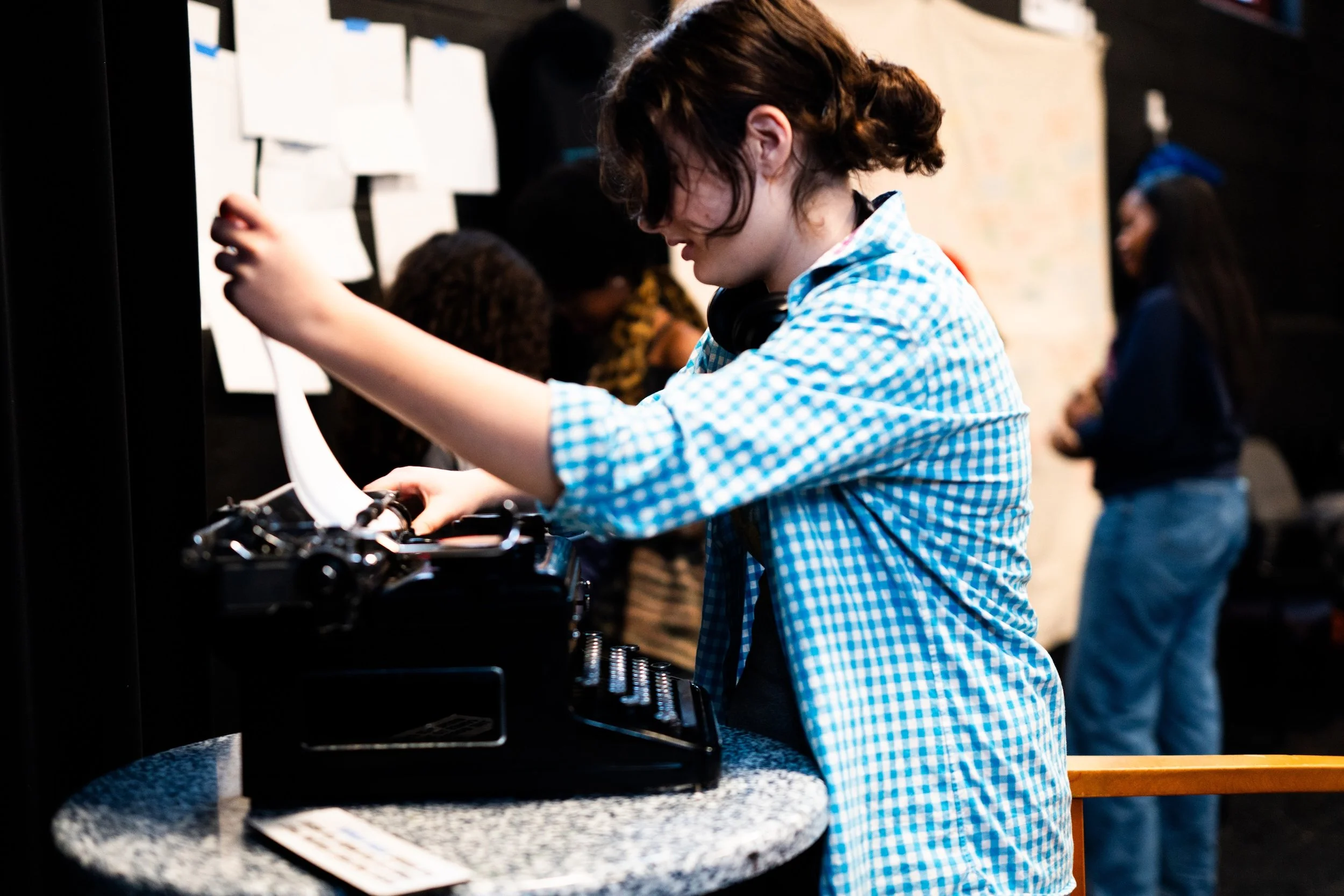
The typewriter was a quiet student favorite. I think partly because of its novelty, but also the physical experience of pressing the keys, and being forced to slow down in a way that is quite different from typing, the students enjoyed. It was planning for this Versescape that I finally found an appropriate name for the typewriter station, dubbing it the Typewriter Exchange. Although the guiding principle is type a poem, take a poem, there were a few students who asked or decided to keep what they had written. There were also many poems taped to the wall for display. Something I want to consider for the future is to encourage more people to take a poem that someone else has written.
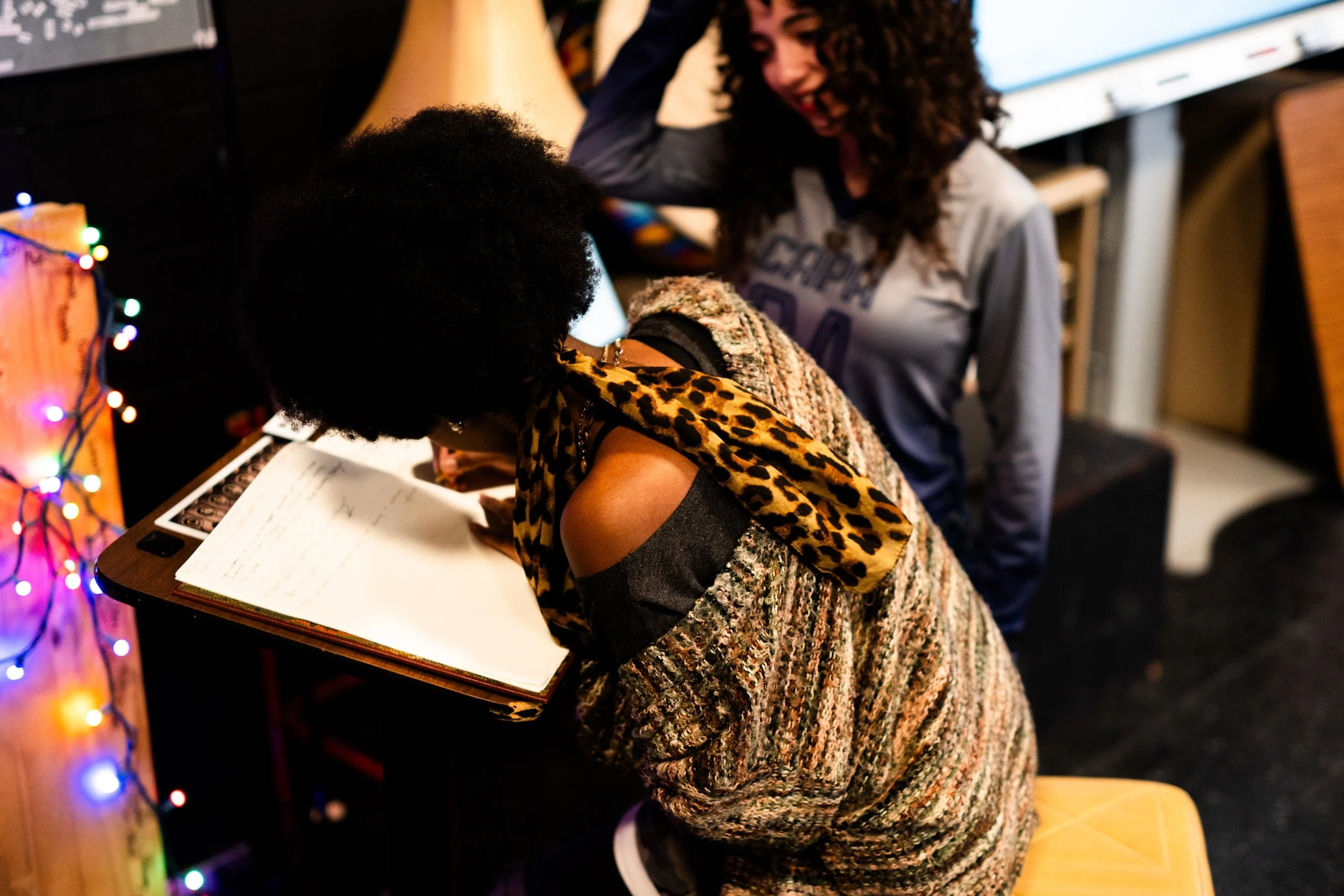
The journal also got consistent use. Besides the typewriter, it was one of the most underutilized components from my first Versescape. Students wrote short sentences -- like words of wisdom to others, rather than longer entries. When introducing the journal to the students, I reminded myself that they themselves were artists and would have their own careers and notoriety, and that I may be the lucky one to have my name next to them in the future. I think the idea of community and being remembered, and coming back to something, almost like a note you write to yourself, but you’re not sure when exactly you’ll get to see it again, resonated. Many students wrote the date next to their entries.
The performance cycle conversations were fruitful. Going into this experience, I wasn’t sure how my poems from Thoughts and Feelings About BEing HUMAN would land with a younger audience. Many of the poems reflected on identity and the reflections that come on the other side of something—experiences that students in high school likely have not yet experienced.
Their depth astounded me. The freshmen engaged with one of the most challenging poems, discussing topics like harsh self-talk. Regarding one of the prompts, which read, “Sometimes harsh self-talk is necessary,” they told me that the word “sometimes” made it harder for them to decide to agree or disagree because it introduced too much nuance. I got rid of the word for future discussions.
With the sophomores, we discussed the word innovation. I reflected on the poem and writing it, as I’m now deeper in my understanding of my work and its direction and talked about how its connotation is often with technology. I discussed how social innovation is something rarely talked about. I took this a step further with the juniors, and with the same poem, encouraged them to use their own artistry to socially innovate if they felt that current social conventions were limiting in the way that they were sharing.
That moment was a special one to me. To push students' creativity and show respect for their own practice and their own identities revealed a key lesson for me: Children have their own ideas they want to develop. My work is not about showing how awesome I, ADSS, or ELA is, but being a spark for others to engage more deeply with themselves and their own work.
I enjoyed the opportunity to engage in a seminar-like discussion with the juniors. Each group was thoughtful, sharp, and clearly thinking about things it took me many lessons to understand in my own life.
V. Data/Impact
Survey data and participant responses revealed consistent patterns in engagement, interpretation, and creative impact across all three grade levels.
Interpretation & Perspective Shift
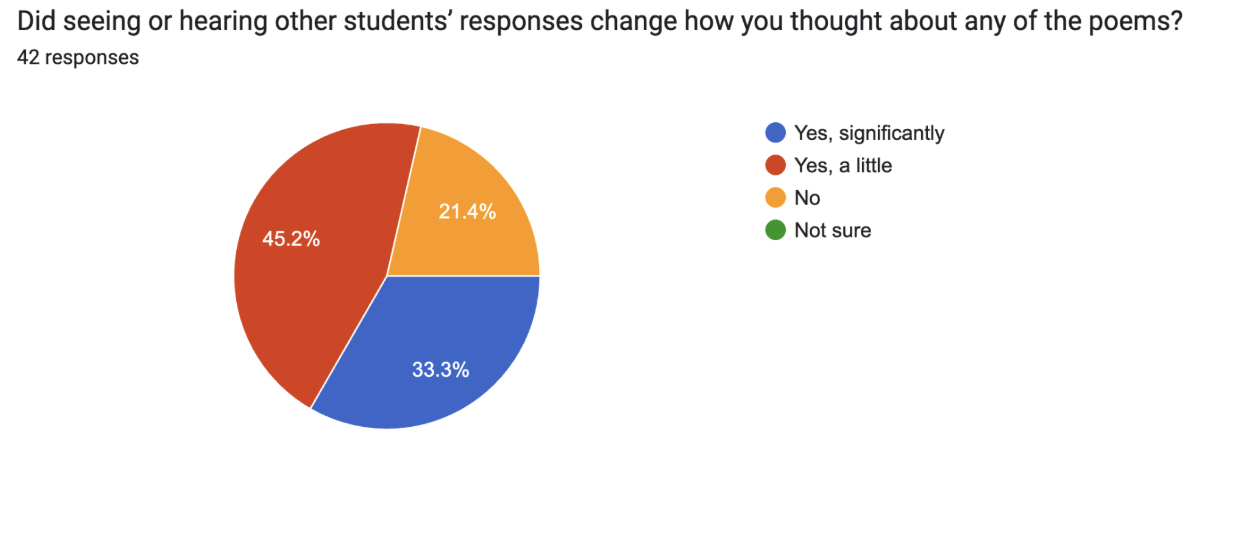
79% of students said that hearing other students’ responses changed how they thought about the poems
Quotes:
“It helped me see other perspectives which is always valuable as a writer.”
“Being able to hear what other people thought vs. what I thought and being able to come to some type of connection.”
“During the poll, people gave reasons for why they believed certain topics were more important than others and my opinion changed a bit because they brought up really good points.”
“I think my views on certain topics brought up were just expanded and built upon what I thought or believed.”
Engagement & Experience
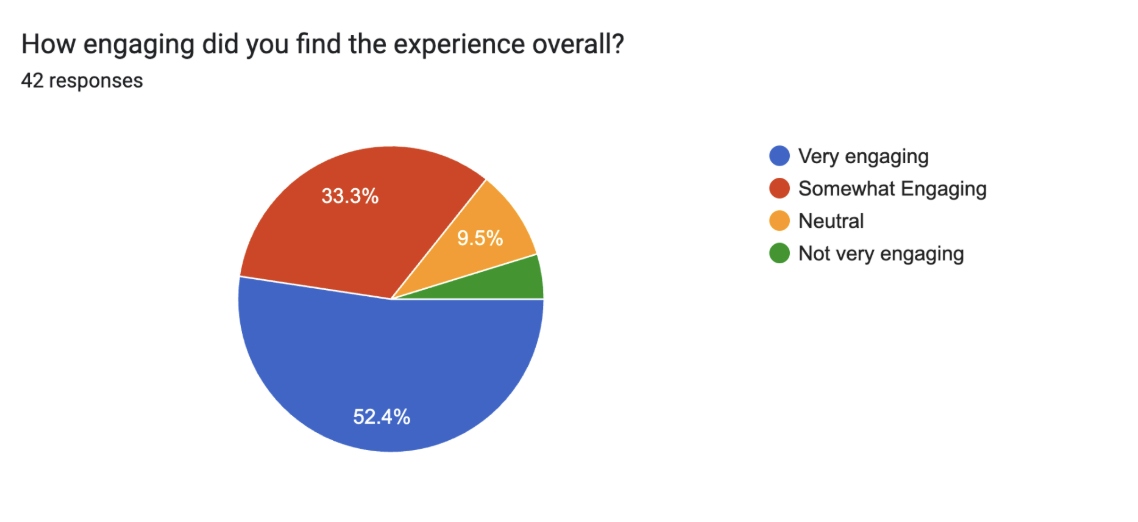
86% of students found the experience “Very engaging" or “Somewhat engaging”
Quotes:
“I related to the second poem a lot. Especially with a line that I still have in my head. Legalization or deportation. A man obsessed with alienation. I love the poem a lot because we have that going on right now in the real world even if this was written in 2024. As a child of an immigrant, it hit hard and made me feel happy to see this whole situation in a poem.”
“I really didn’t relate to most poems”
“Most of the things about connection and mostly getting over your fears. I am so unimaginably overambitious for my own good, so I tend to get really into an idea and then the idea that I have only now (yes, right now) to do it kicks in, and that leaves me feeling really unmotivated. Starting will always be the hardest part.”
“I found the premises of the poems interesting, but the execution was uninteresting and unoriginal, and downright pretentious in some parts.”
“At the end of a poem, the speaker talks about stars, and I really, really loved that line. I connected with it a lot.”
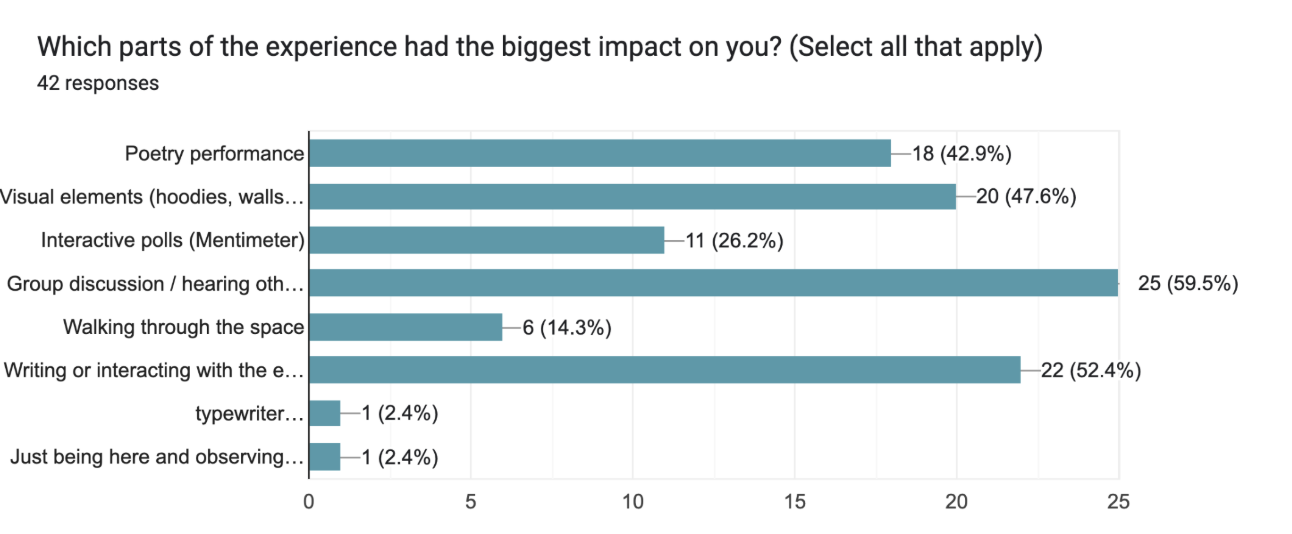
60% of students said group discussion and hearing others' responses had the biggest impact on their experience
52% said writing or interacting with the installation had the biggest impact
Creative Impact & Future Behavior
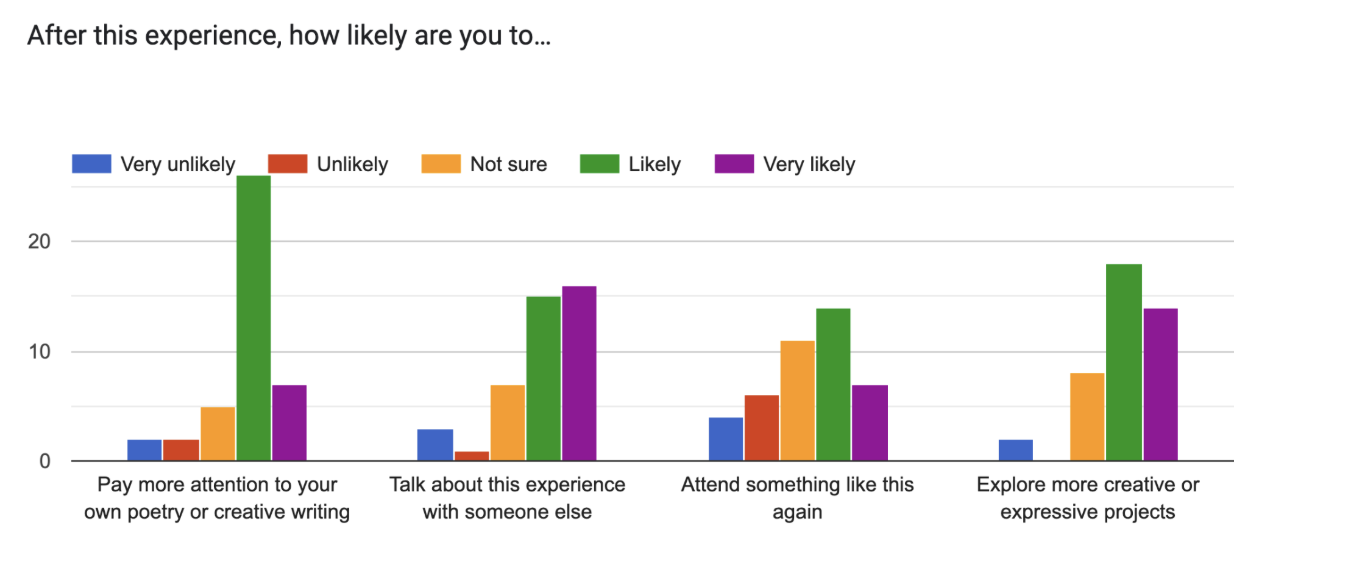
79% of students reported that the experience is likely to increase their attention to their own poetry and creative writing
50% said they are "Likely" or "Very Likely" to attend a Versescape again
“Armstead was open and responsive to all of their feedback, at times probing them to think further and extend their creativity...As a teacher of nearly 15 years working with outside guests, this was the most seamless preparation and execution I've experienced!”
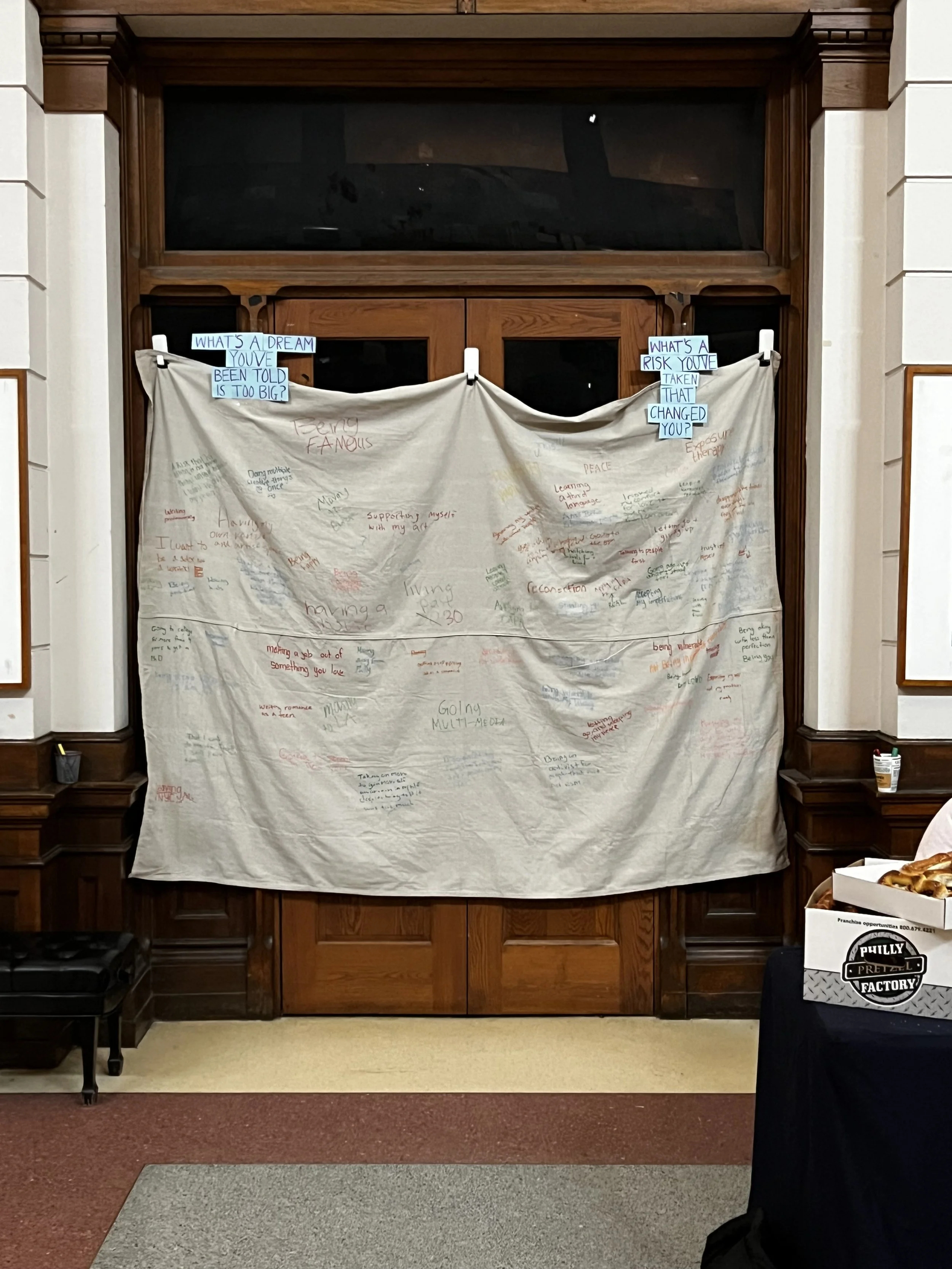
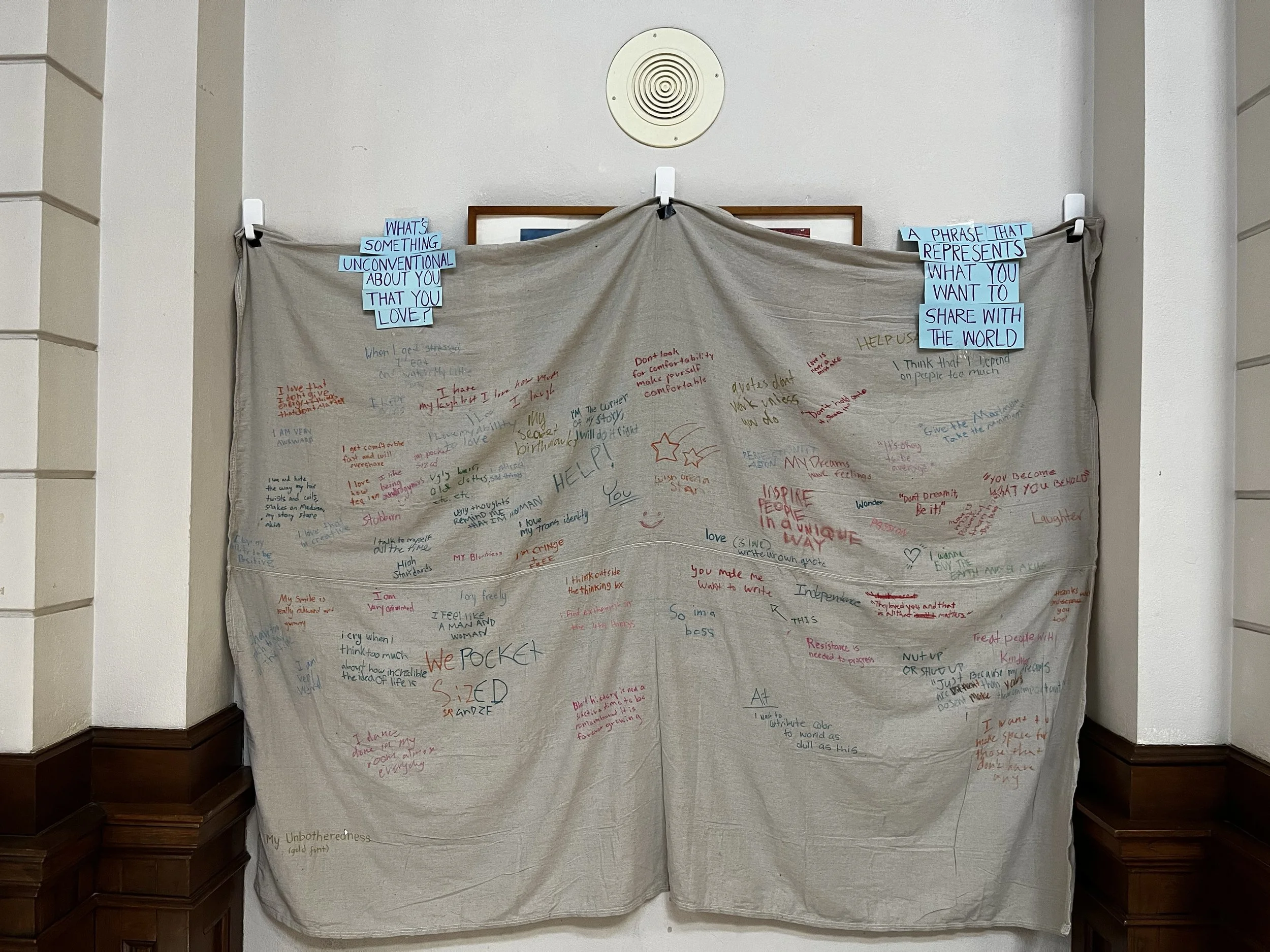
— Rachel Harr, CAPA High SchoolThe Textual Tapestries from the Versescape were hung in CAPA’s Grand Hall during the week of March 16, 2026, for their Writer’s Cafe -- a student performance specifically for the Creative Writing students of CAPA.
VI. Reflection / Future Considerations
Taken altogether, the CAPA Versescape not only engaged students but also encouraged critical thinking, creative risk-taking, and fostered reflection on their own work. The combination of performance, interactive installation components, and peer discussion created a measurable impact on students’ engagement with poetry.
It wasn’t until the discussions started that I truly began to understand and appreciate the perspectives the students were bringing to my a cappella poetry performances and to the discussions overall. Consistently, they reflected on their own lives and found the nuances of where they saw themselves, or the world around them, and formed their own perspectives which they were willing to share.
They shared honest reflections across the installation, as a visitor could read everything from a student acknowledging the risk in sharing their sexuality, to fake friends, to even taking a chance and applying to CAPA. The students took the opportunity to share their voices seriously, and this allowed them to be heard in new ways and in a space that invited open dialogue.
Two weeks out from taking the installation down, several themes have emerged. The main one I’ve noticed in my reflections is bringing in student voice, not just structurally where it was already present, but through me.
Student Voice
One way I want to do this going forward is to learn more about what the students’ passions are. For this Versescape, I led and facilitated, but it’s clear that I was in a room among many artists. Encouraging more dialogue between myself and the students, I think, would have helped more students feel seen. A few students approached me after the performance to share work or ask questions; I want to make this a more accessible opportunity for all students in future iterations.
Related to the data, I was a bit discouraged that only 50% of students said the experience was something they were likely to do again. My hopes are that by allowing students to share more about themselves, a school iteration of the Versescape becomes something students want to return to more readily.
For the guided tours I led off with, I wish I had referenced some of the language already present. A line from a tapestry. A poem from the Typewriter Exchange. A message in the Living Journal. All of these were opportunities to bring in student voice and to show the incoming group that their peers were already shaping the space.
Versescape Modularity
Regarding my project Thoughts and Feelings About BEing HUMAN, it was my first a cappella poetry EP, and it wasn’t designed for high school students, though this experience showed me they can handle some of the themes. I wonder what a project designed specifically for high school-aged students might look like. While the prompts I used could be further refined, the students had plenty to share with the current prompts across all installation components.
This is a future consideration related to the modularity of the Versescape format that I want to dive deeper into when resources allow. While components (the tapestry, the journal, performance, etc.) remain the same, I’m considering how I can shape the environment, through language, to encourage deeper connection and participation with the target audience.
Logistics
Logistically, while each session was 90 minutes, I felt that 75 would have been the perfect amount of time. There was some lingering at the end of each session, though the freshman had the most and ended close to 20 minutes earlier. They casually engaged and talked during the remaining time. The sophomores who probably had the richest performance discussions used closer to 85 minutes.
I also wonder if 90 minutes is better for adults than students. The lingering and socializing is part of the experience and the connections that can form in a Versescape, and depending on the venue, there won’t be hard stops like there are within a high school bell schedule structure.
Comparing Data to My First Versescape
One thing that will evolve over time is the data collection for a Versescape. I’m excited about the feedback that I collect and how it can be used to evolve Versescape over time, and one powerful measure will be comparing data from Versescapes.
The data from my first Versescape was specifically designed to reflect on the performance cycle, while this survey for CAPA was a reflection on the entire experience.
While there are too many variables for direct comparison, the group discussion across both survey groups seems to be an impactful part of the experience. The ability to hear varying perspectives, rather than reflecting alone, is a key aspect I want to continue to refine in my practice going forward.
These reflections point toward a clearer understanding of how Versescape can evolve across educational settings.
Center student voice as co-creator to enhance engagement
Guided tours should reference existing student contributions to build continuity
Session length may need adjustment depending on the audience
Modular prompts can be adapted to age and context
Peer discussion consistently drives perspective shifts
Key Takeaways
Closing Thoughts
It’s been an honor to work with talented students and such a supportive partner in Rachel Harr, CAPA, and Kelly Writers House at the University of Pennsylvania. Rachel and I have discussed continuing the partnership into the future, which I’m excited about.
There’s more to learn and much to improve with Versescapes. But the foundation is real.
from love,
towards togetherness,
in forgiveness,
Armstead / ADSS